
The Treasury Stock Method (TSM) is used to compute the net new number of shares from potentially dilutive securities. Under the cash method, the treasury account would be debited for $50,000 and cash credited for $50,000. If the equity ownership of a company is more concentrated, takeover attempts become far more challenging (i.e. certain shareholders hold more voting power), so share buybacks can also be utilized as a defensive tactic by management and existing investors. Take self-paced courses to master the fundamentals of finance and connect with like-minded individuals.

Treasury Stock Contra-Equity Journal Entry
While they do produce different amounts within the subcategories of equity, the alternatives do not produce different measures of total stockholders’ equity. This result should not justify haphazard or inconsistent treatment of treasury stock transactions. In the last part of the formula, the number of shares repurchased is deducted from the total potential shares issued to calculate the net dilution, which is completed for each of the three option tranches. However, since we are accounting for the impact of potentially dilutive securities, we must calculate the net impact from in-the-money options. Suppose a company has 100,000 common shares outstanding and $200,000 in net income in the last twelve months (LTM).
Which of these is most important for your financial advisor to have?
But this number ignores the fact that 10,000 shares can be immediately issued if the in-the-money options and warrants are exercised. The cost method of accounting values treasury stock according to the price the company paid to repurchase the shares, as opposed to the par value. Using this method, the cost of the treasury stock is listed in the stockholders’ equity portion of the balance sheet. When a company initially issues stock, the equity section of the balance sheet increases through a credit to the common stock and the additional paid-in capital (APIC) accounts.
Are treasury shares considered as outstanding stock?
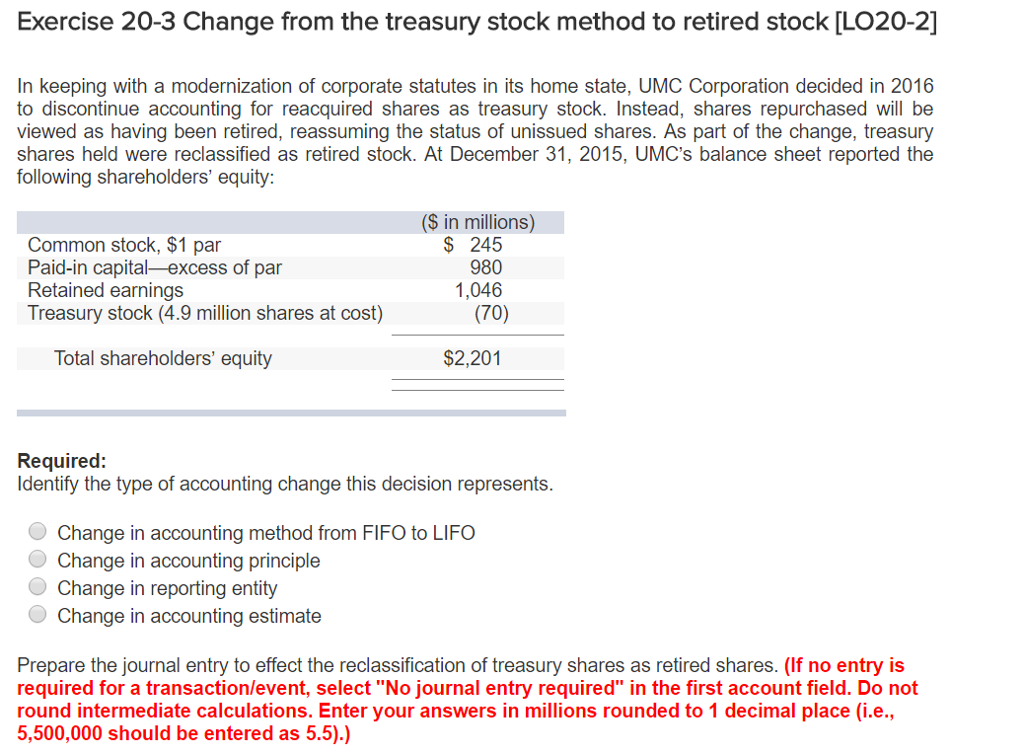
- With the exception of the possible impact on the amount of legal capital, these shares are in substance the same as unissued shares and should generally be accounted for under that assumption.
- First, the amount of treasury stock is generally limited by state law to the balance of retained earnings.
- This means that when the business winds up, all the liabilities of the business are transferred to its owners.
Therefore, an increase in treasury stock via a share buyback program or a one-time buyback can cause the share price of a company to “artificially” increase. They can be in the form of both common and preferred shares, depending on whether free freelance independent contractor invoice template investors prefer risk or reward. These shares do not receive dividends and cannot effectively vote at meetings. These shares belong to the issuer even when they were initially issued at a discount rather than the market price.
Journal Entries for Treasury Stock Transactions
Treasury Stock is credited for the total cost of the shares sold, and the account Additional Paid-in Capital from the Sale of Treasury Stock Above Cost is credited for the difference. By purchasing shares from stockholders, the corporation can use them, for example, as part of the compensation to executives without having to go through the legal difficulties of amending the Charter to allow additional shares to be issued. A corporation’s board of directors may decide to acquire treasury shares for various reasons.
When the shares are reissued, Cash is debited for the proceeds and Treasury Stock is credited for the par value of the shares. Any additional credit is recorded in Capital in Excess of Par, just as if the stock is being issued for the first time. At the time of acquisition, the Treasury Stock account is debited for the par value of the shares, and Capital in Excess of Par is debited for the original amount paid in excess of par at issuance. First, listed companies must report and announce the information of share repurchase to the FSC by the ‘Regulations on Share Repurchase by Listed Companies‘ and input it into the Market Observation Post System (MOPS). Among this information, the cost of the repurchase should be determined by the FSC.
However, the case could be made that to be more conservative in the diluted share count calculation, the number of outstanding options should be used despite not all being exercisable on the date of the valuation. This is done to reflect the reality that the majority of unvested options have a high probability of vesting someday, which is a practice that investors and firms have increasingly adopted in recent years. A treasury paid-in capital account is also either debited or credited depending on whether the stock was resold at a loss or a gain. Under the TSM, the options currently “in-the-money” (i.e. profitable to exercise as the strike price is greater than the current share price) are assumed to be exercised by the holders.
Further, a company might buy back shares and in turn issue them to employees pursuant to an employee stock award plan. Note that only the securities deemed “in-the-money” are assumed to have been exercised, therefore those “out-of-the-money” are not included in the new share count. The reason is that the denominator (the share count) has increased, whereas its numerator (net income) remains constant. That said, if a company has issued such securities in the past (i.e., the potential for conversion), its diluted EPS in all likelihood is going to be lower than its basic EPS. Partnerships, on the other hand, are businesses that have more than a single owner.